Pages

Tuesday, November 12, 2013

More on Sumner Likening the Obama Administration to the 'Mafia.'

     I already wrote about this last night-Sumner is claiming that the Obama Administration is like the Mafia shaking down shopkeepers. 

     http://diaryofarepublicanhater.blogspot.com/2013/11/sumner-tight-money-unemployment-and-bad.html#comment-form

     The only hitch is that the shopkeepers he has in mind are Wall Street banks like JP Morgan and even Wall Street hedge funds. I see in the comments section at Money Illusion that Geoff-who we've established beyond a shadow of the doubt to be Major Freedom-accuses me of lacking nuance in my comments. 

    "Mike don’t be a fool. He wasn’t “equating” banks with shopkeepers. He was likening the behavior of the Obama administration’s behavior against banks with the behavior of mafias against shopkeepers. You know, shakedowns."

   "And you’re lumping every bank into a “they deserve it” bin. That’s incredibly crude. What about the employees who end up in the cross fire? Collateral damage, huh? Yet they incur some of those costs. You think all 100% comes only from the fat cat executives who smoke cigars and carry money bags with dollar signs on them?"

    "Where’s the nuance in your analysis?"


   Well I like 'nuance' as much as the next guy, though, I suspect that in the way Geoff uses it here it probably means that the banks are always innocent and the government always guilty. Nuance is often a very helpful ploy in blaming the victim as well. 

    So in composing an answer to Geoff-MF I actually touched on something I initialy forgot to mention. 

   “Take the settlement agreed to by JPMorgan. The accompanying statements from both the bank and the regulator involved, the Federal Housing Finance Agency, provided no indication of what the firm did wrong and no admission of guilt.”

   "Speaking of nuance I think the wrong nuance is being given to this statement. The fact that JP isn’t copping to anything here doesn’t mean it’s innocent. Actually it’s a break for them. Often you see companies do that- where they know they’re guilty but agree to pay a fine with an agreement they don’t have to admit to anything."

   "The prosecutor takes the deal so they can avoid a lengthy court fight. As I read this both JP and the prosecutor probably realized that this could go on for a long time and so JP agreed to ‘no contest.’

     "It’s not a question of simply ‘they deserve it’-though it is a fact that they all took in much higher numbers in bailouts than any of them are paying now. This is the law-Dodd-Frank."

     "So for the Obama Administration there hasn’t been any breach of the rule of law-to the contrary as this quote makes clear it is actually enforcing Dodd-Frank. Now you may not like this law-I don’t see how anyone can prefer the previous status quo but that’s another matter-but there is nothing thuggish about them enforcing it-unless you think they simply should ignore every law based on whether someone out there disagrees with it."
I
   "I mean because you disagree with it Geoff, or Scott does doesn’t mean that it’s thuggish for a law that passed by the democratic process to be enforced."

    "And of course, while I eluded above to the fact of GOP gerrymandering, beyond that the fact is that there is nothing wrong much less illegal for the Administration to do this without GOP House approval even if their majority were legitimate-which it isn’t. This is, again, because Dodd-Frank was passed through the normal democratic legislative process."

   "The GOP had it’s chance to stop it then and they failed to do so. I can imagine the Darrell Issa investigation of ‘shakedowns of JP’ and testimony after testimony amounts to ‘Congressman it’s the law, maybe you should take some time and actually learn that before you waste more taxpayer money on one of your fishing expeditions.’

    So I guess I should be grateful to Major as this got me to thinking. Sumner is complaining that Obama is enforcing a law duly passed in the legislative process. 


Monday, November 11, 2013

Sumner, Tight Money, Unemployment and Bad Analogies

     This post of his is a gem in that he just makes bad analogy after bad analogy-it's some kind of savant talent to come up with analogies this bad. He starts off with complaining that if you kill one man you go to jail but kill many and they build you a statue. 

     Fair enough, but wait to you see what he's likening this too:

     "There’s an old saying that if you kill one man they put you in prison, if you kill 100,000 men they build a statue in your honor. A new article in The Economistsuggests a corollary; if an individual extorts money he’s put into prison, if a government extorts money it’s praised for getting tough on banks:

To a public angry at banks for their role in the financial crisis, this may all seem like reasonable retribution. Yet in many cases the rush to punish is overturning basic principles of justice. Take the settlement agreed to by JPMorgan. The accompanying statements from both the bank and the regulator involved, the Federal Housing Finance Agency, provided no indication of what the firm did wrong and no admission of guilt. JPMorgan is the fourth institution to settle over its dealings with Fannie and Freddie without going to trial, following settlements by General Electric, Citigroup and UBS.
Bank executives contend that they have little choice but to accept punitive settlements because the alternative, facing a criminal indictment and going to court, could destroy their businesses, even if they are subsequently found not guilty. This is because they risk losing their banking licences or being shunned by clients while charges are pending. In some cases regulators make these threats explicitly. Last year New York’s financial regulator threatened to revoke the state banking licence of Standard Chartered, which would in effect have excluded the British bank from America. “If you’re a financial institution and you’re threatened with criminal prosecution, you have no ability to negotiate,” Warren Buffett, an investor, said recently. “Basically, you’ve got to be like a wolf that bares its throat…You cannot win.”

     "Most people react to this type of story that an emotional level; either the banks deserve what they’re getting (liberals) or they’re being treated unfairly (conservatives.) Let’s try to rise above emotions and look at this from a public policy perspective. I see two other issues here:

1. This allows President Obama to raise taxes on banks without congressional approval:

JPMorgan Chase agreed to the biggest of these settlements, of $5.1 billion (with perhaps billions more to come) related to mortgages that it, and banks it later acquired, had sold to two government-backed firms, Fannie Mae and Freddie Mac. In Europe Rabobank, a Dutch co-operative, agreed to pay almost $1.1 billion after admitting that some of its employees had joined in the manipulation of LIBOR, a benchmark interest rate. Piet Moerland, its boss, resigned. In Germany Deutsche Bank set aside €1.2 billion ($1.7 billion) in provisions for litigation. Swiss regulators told UBS to set aside 586m francs ($652m) against possible legal costs and fines.
A billion here and a billion there soon add up. SNL Financial, a data firm, reckons that over the past three-and-a-half years America’s six biggest banks have agreed to pay more than $65 billion in settlements related to the financial crisis and mortgages. Further claims and expected settlements will soon push this figure to $85 billion, it says.
Add in settlements agreed to or being negotiated by European banks and the bill easily tops $100 billion. These include the $1.9 billion fine imposed on HSBC over weak money-laundering controls, the $1.5 billion settlement agreed to by UBS for manipulating LIBOR and the £16 billion ($26 billion) British banks have set aside to compensate customers who bought useless loan-insurance policies. It is not just banks in the firing line. SAC Capital, a hedge fund, was expected to reach a $1.2 billion settlement of criminal charges relating to securities fraud as The Economist was going to press. This follows an earlier $616m settlement of civil claims against the fund.

    "Whenever the Obama administration needs more tax revenue they can simply “ask” banks for more money. Just like someone in the Mafia might “ask” a small shopkeeper for some money. In the old days the GOP-controlled House of Representatives would’ve been able to stop the Obama people from raising more revenue. That is no longer true."


      Well if it's no longer true it's just as well as the GOP only controls the House thanks to gerrymandering. We need more revenue anyway and since the GOP won't do it's job in compromising with Democrats over revenues and they weren't elected in the first place, it's just as well. 

    The bad analogies just come fast and furious. We're to see the Obama Administration as the Mafia and the Wall Street banks and hedge funds as poor victimized 'shopkeepers.'

     As usual he imagines himself as being 'above emotion' when it's obivous but such bad analogies that nothing's further from the truth. I love the name of this post too: 'The consequences of tight money go far beyond unemployment.' So Sumner wrote this post for those who aren't too worried about unemployment but are really concerned if they hear that JP Morgan hasn't been treated nicely. With all the money they received from us-via the same govt that Sumner is now slandering as a 'Mafioso' we're supposed to be concerned that they actually had to pay back a small amount in fines?

      Whatever Sumner's talents are-he has a number of them, starting with a shocking intellectual sophistry-having any sense of proportion sure isn't one of them-which is surprising as he's so beyond emotion. 

For Sumner There's Good Fiscal Austerity and Bad Fiscal Austerity

     Sumner affects to agree with Krugman with 'just one quibble.' This quibble is a doozy. Sumner has reacted incredulously when I've argued that he's in fact a proponent of fiscal austerity. Why would I think that? Just because he's constantly claiming that the sequester has done no harm-and so implicitly it's a fine thing?

    Here Sumner sort of claims to agree with Krugman in damning fiscal austerity in eurozone. 

    "So the ECB made a big mistake in 2011 by not offsetting fiscal austerity.  Krugman and I agree on that point.  The eurozone was not at the zero bound, so austerity should not have reduced demand, even using Krugman’s model.  One irony here is that Krugman may be partly right about the fiscal multiplier, but for essentially supply-side reasons.  One problem in 2011 was that inflation was running above target.  And that was partly due to various tax and fee increases designed to close the large budget deficits.  The ECB reacted to these tax increases by raising rates several times in 2011.  In an AS/AD model the tax increases shifted AS to the left, raising inflation and reducing output, and the ECB reacted by shifting the AD curve to the left.  So fiscal austerity was a mistake."

     http://www.themoneyillusion.com/?p=24702

    Ok, so Sumner thinks fiscal austerity was a mistake?! Well, actually... no:

     "Or perhaps the real problem was the specific type of fiscal austerity.  My analysis, combined with the ECB’s insane preference for inflation targeting, suggests that demand-side fiscal austerity would have been desirable. Raise the employee-side payroll tax by 4 percentage points and lower the employer-side payroll tax by 2 percentage points.  That sort of fiscal reform would have lowered inflation and thus caused the ECB to cut rates in 2011, instead of raising rates."

      Now that's the Sumner I know and love. Demand side fiscal austerity is all to the good. We should increase the employee side payroll tax while cutting it for their employers. He hasn't like it when I've compared him to Alesina, but this is exactly the same fiscal policy Alesina called for. 

      "In March 2011, the new Tea Party had taken over the House, and it needed a plan for what it would do about the deficit. It proposed that the effects of imposing austerity, even when the economy is weak, "may be strong enough to make fiscal consolidation programs expansionary in the short term." How did it propose we cut the budget? We can look at Joint Economic Committee (JEC) Republican report, "Spend Less, Owe Less, Grow the Economy," for the answer:

     "The Tea Party's study called for 85 percent spending cuts and 15 percent revenue increases. This was based largely off a 2009 study by Alberto Alesina and Silvia Ardagna of Harvard titled "Large changes in fiscal policy: taxes versus spending." This is the ur-text of expansionary austerity, which made the case, for example, "On the demand side, a fiscal adjustment may be expansionary if agents believe that the fiscal tightening generates a change in regime that 'eliminates the need for larger, maybe much more disruptive adjustments in the future.'"
     Anyone want to tell me there's any difference-on fiscal policy between Sumner, Alesina and the Tea Party's study? You could say they're separated at birth. 
     

Sunday, November 10, 2013

Rational Expectations vs. Adaptive Expectations: Robert Waldman Ask Who You're Calling Stupid

     I looked at Simon Wren-Lewis' post arguing for RE yesterday.

     http://diaryofarepublicanhater.blogspot.com/2013/11/simon-wren-lewis-makes-case-for.html?utm_source=feedburner&utm_medium=feed&utm_campaign=Feed%3A+DiaryOfARepublicanHater+%28Diary+of+a+Republican+Hater%29

   In that post I had quoted Nick Rowe as well who seemed to maybe be saying something a little different from WL on the question of AE. However, in the comments section, Nick made it clear that he basically agrees with WL-adaptive expectations assumes 'people are stupid.'

  "There are many worlds in which adaptive expectations would be rational. BUT, the key insight of Rational Expectations was that, even in those worlds, the parameter B will not be a constant. B will depend on how X(t) actually varies in the world you live in. For example, if X(t) is a random walk, a rational person would have B=1. And if X(t) is white noise, a rational person will have B=0. And so on. That was an important insight."
  "I'm (just) old enough to remember Adaptive Expectations in the days.  Rational Expectations. And we really did assume people were totally stupid; we assumed (without really realising this) that people could be surprised on the upside again and again and again, while never adjusting their rule of thumb to stop making those obvious repeated mistakes. Some economists do go a bit overboard with RE, in ignoring the problems people face in figuring out the world has changed, especially if the world is complicated. But we were way worse in the olden days."
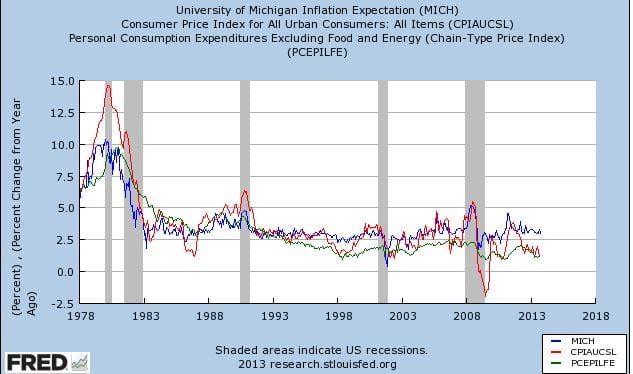
    Waldman over at Angry Bear has his own response to WL. He argues that the RE approach certainly gave policymakers the wrong implications of the effect of the sharp disinflation of the early 80s. He then provides an 'ad hoc CPI model' which seems to show that AE does quite well. I'll cut and paste the chart for you as I have a litle trouble reading it-it's too small. 
   "I ask Professor Wren-Lewis how often he looks at a graph like the one below (made at FRED). I am asking for information and I hope to get an answer.
wren

     "The blue curve is inflation expected by ordinary people from the Michigan Survey, the red curve is cpi inflation in the yer till the date of the survey and the green line is core inflation (CPI minus food and energy). It seems to me that survey expected inflation is equal to CPI inflation except when CPI infation is extraordinarily different from core inflation because of a recent Iraqi invasion of Iran or theh 2008 collapse of demand for, among other things, petroleum. This simple ad hoc model CPI or core if very different fits the data rather well. I would say its empricial success is vastly greater than the empirical success of any micro founded macro model..I note that my model is much more naive than the paleo-Keynesian approach. Adaptive expectations are a weighted sum of the old expected inflation and lagged actual inflation. They smooth off peaks as in 1980 and early 2009. The blue curve looks like the red curve smoothed is a pretty good summary of data all of which was collected *after* rational expectations assumption was declared the winner of the debate."

    "There is another anomaly. In recent years Michigan survey forecast inflation is persistently higher than actual inflation. At the same time the general public’s estimates of achieved inflation are higher than official calculations. The rational expectations assumption has very strong implications for statements about data available at the time the statement was made. These implications are totally rejected by the data.

- See more at: http://angrybearblog.com/2013/11/rational-vs-adaptive-exectations.html#comments

    Waldman argues that it's reasonable to assume AE for developed countries with the exception of those experiencing hyperinflation.

    A commentator at AB makes a good point as well:

    "Here’s a question I asked Wren-Lewis but didn’t get a response. Either my question was idiotic or there really isn’t a good answer."

    "Isn;t adaptive expectations a property of the *aggregate*? Assuming AE assumes nothing about the behaviour of individuals. So the claim that AE assumes agents are stupid, is stupid. Is the fallacy of composition so deeply entrenched in macroeconomists’ thinking that they are unable to even imagine that the individual and aggregate can behave in ways that are very different? It is entirely possible that some individuals do indeed have ‘adaptive expectations’, but it is not necessary. AE is a simple heuristic for capturing the inertia in the behaviour of aggregates . How the behaviour of diverse agents, heterogeneous along multiple dimensions, aggregates to inertia in the aggregate is an important but separate question."

    As to the issue of 'idiotic questions' it's  kind of par for the course that establishment Neoclassical economists love to play the Sumner care that 'you're too ignorant to have a conversation with.' WL engages in it too. 


   Herman also references the hyperinflation paper of Sargent where he looked at AE vs. RE and RE seemed not to do well-yet this was not fatal to RE-quite the opposite. 

   HT: Nanute

   P.S. I hope Waldman gets an answer too but we know that WL has some skepticism about the fitness of heterodox economists to have a conversation with the NCers-though he is certainly much more open minded and friendly than Sumner who's pompous attitude is almost a caricature 

   P.S.S. We can see the fault lines of the Macro debates in several different ways. We can conceptualize it as heterodox vs. orthodox-ie, Neoclassical-economics. We can see it as Monetarism vs. Keynesianism-with Sumner's current brand of Market Monetarism as the latest salvo in a longer debate. 

   The trouble with the Monetarist vs. Keynesian conception is that there is a good deal of overlap between 'Keynesian' and orthodox econ. There is heterodox Keynesianism and there's orthodox Keynesianism-Joan Robinson's 'bastardized Keynesianism.'

   I think overall, the true fault lines are Keynesian economics vs. pre-Keynesian economics. Current Neoclassical New Keynesian economics is a kind of amalgamation of the two-it accepts Keynesian economics but dilutes this by insisting that all Keynesian analysis must justify itself in front of a pre Keynesian peer review-this peer review is called microfoundations. 

   So in principle I disagree with RE because it's pre Keynesian economics-it claims that we can only analyze the macroeconomy with reference to explaining it in microeconomic terms. It's still methodological individualism after all these years and, ergo, it's pre-Keynesian. 


Saturday, November 9, 2013

Now We're Talking: Mike Norman and Walter Mosler Join the Fight Against Sumner's Triumphalism

     I've stated many times that I do think you can't just let Sumner get away with all this ball spiking without engaging at all-mostly because more people will believe his disinformation. Sumner likes to think that he's part of an economic elite where nobody who isn't part of this elite doesn't even have an opinion worth anything. Yet he's never heard of confirmation bias evidently as all cats are grey and every piece of economic data proves MM right. 

   I admit I was very pleasantly surprised to receive this comment by Mike Norman himself on the latest bout of Sumner's gloating:

   "Here's the response: Total government spending in 2013 has been higher than 2012. The Keynesian model has not failed anyone. Please see Daily Treasury Statement for FY 2013 ending Sep 30. Here. So despite the sequester and tax increases, total spending has still been higher than 2012. I'll just give you the numbers: FY 2012 $4.18T vs FY 2013: $4.2T."

    http://diaryofarepublicanhater.blogspot.com/2013/11/sumner-is-at-it-again-after-latest-job.html?showComment=1384047284134#c1623075796450175322

  Again, very gratified that Mike dropped by to leave a comment on my humble blog. I was further gratified to see that he got these numbers from that man himself-Warren Mosler. Exciting stuff. 

  http://mikenormaneconomics.blogspot.com/2013/11/mike-sax-sumner-is-at-it-again-after.html

  I had started this piece with a plea for engagement and nice to see it's forthcoming. 

  "I guess it falls to me to have to respond as no other Keynesians of any stripe seem to want to take a whack. He's clearly all but begging for a response."

  We got some response. I'd say for anyone out there who has some good data and analysis in this debate to come forward and let us hear about it. This is going to have to be a team effort if we really want to get at the truth of the economic and monetary world. I by no means have all the answers though I do think one thing I do is often ask the right questions-or at least I'm asking questions. 

   I will say though that I' m not sure of what to make of the idea that govt spending is up this year. Colin Roche has been declaring it's the opposite. 

   http://pragcap.com/what-if-barack-the-government-job-slayer-had-been-more-like-reagan-the-government-job-creator

   Haven't we seen a drop in govt spending over the last 4 years starting in 2010? Of course, part of it is that the biggest govt job losses have been at the state level. Still how has spending gone up with the sequester? I trust Mike and Mr. Mosler's data but how exactly did this happen?


Simon Wren-Lewis Makes the Case for Rational Expectations

     It's one of those zombie ideas that just won't die. Yet reading SWL's explanation is helpful in understanding why. SWL is hardly an obnoxious Scott Sumner type, he's a New Keynesian who's heart is basically in the right place and I probably would agree with him on many policy prescriptions. Still, in reading him you see that RE is about a lot more than Sumner. 

    It remains a dominant theoretical belief of the mainstream macro establishment and has been at least since the late 50s. SWL s answer for why seems to be there's nothing better to replace it with:

    "This discussion can easily get populated with straw (super)men, so let's be clear about some things. It is not a debate about rational expectations in the abstract, but about a choice between different ways of modelling expectations, none of which will be ideal. This choice has to involve feasible alternatives, by which I mean theories of expectations that can be practically implemented in usable macroeconomic models. In the past, I have attempted to try and start a dialog with heterodox economists on the level of practical macroeconomics, to get beyond the fine words and phrases. It did not seem to work.  I tried again in that recent post, asking for practical alternatives to rational expectations. Professor Syll referred me to behavioural economics, or Frydman and Goldberg’s ‘Imperfect Knowledge Economics’. But perhaps I did not make it clear what I meant by practical."

     http://mainlymacro.blogspot.co.uk/2013/11/defending-rational-expectations.html

     Prior to the rise of RE in the late 50s economists hued to a belief in adaptive expectations where economic agents presume that he future will look largely like the past. SWL seems to think that this theory is insulting to the very intelligence and dignity of man:

   If I really wanted to focus in detail on how expectations were formed and adjusted, I would look to the large mainstream literature on learning, to which Professor Syll does not refer. (Key figures in developing this literature included Tom Sargent, Albert Marcet, George Evans and Seppo Honkapohja: here is a nice interview involving three of them.) Macroeconomic ideas derived from rational expectations models should always be re-examined within realistic learning environments, as in this paper by Benhabib, Evans and Honkapohja for example. No doubt that literature may benefit from additional insights that behavioural economics and others can bring. However it is worth noting that a key organising device for much of the learning literature is the extent to which learning converges towards rational expectations.

   "However most of the time macroeconomists want to focus on something else, and so we need a simpler framework. In practice that seems to me to involve a binary choice. Either we assume that agents are very naive, and adopt something very simple like adaptive expectations (inflation tomorrow will be based on current and past inflation), or we assume rational expectations. My suspicion is that heterodox economists, when they do practical macroeconomics, adopt the assumption that expectations are naive, if they exist at all (e.g. here). So I want to explain why, most of the time, this is the wrong choice. My argument here is similar but complementary to a recent piece by Mark Thoma on rational expectations."

     I don't really see why believing that the future will resemble the present is so unreasonable. Obviously the future will be different in important ways. The truth is it's impossible to wholly predict the future. Kenynes argued that all we really have are conventions and 'rules of thumb'' in which case it's not unreasonable to assume that there will be many similarities even if this proves wrong. The trouble is there is no omniscient position. Further down in the piece, SWL further defines what he means by 'stupid.'

     "To assume, as mainstream macroeconomists once did, that these expectations just depend on past observations about inflation seems to assume that agents are stupid. These agents ignore everything that economists and the media say about inflation: they ignore monetary policy, and whether the economy is in a boom or recession. Now if getting expectations right did not matter too much to these agents, then maybe such naivety would be understandable. But in this case making expectations errors can mean getting real wages or profits wrong, so it matters."

      I mean an agent may figure different aspects of these things in-it depends on the agent, which gets us into the debate over the representative agent model and homegeity of agents. 

     http://en.wikipedia.org/wiki/Representative_agent

     https://www.aeaweb.org/articles.php?doi=10.1257/mac.1.2.29

     I''m with the heterodox guys here. I think something better than RE is possible. More generally, I think that microeconomics must be put in it's place: the whole idea of microfoundations I think is wrongheaded. What it comes down to is that Keynesian economics can only validate itself in front of a pre-Keynesian peer review. I do think that Nick Rowe took a pretty reasonable attitude to such debates however, 

    "Suppose you lived in a world where the price level followed a random walk. (That's sorta like the Gold Standard world). The naive expectation of 0% inflation would be rational in that world."
    "Suppose you lived in a world where the price level followed a random walk plus 2% drift. (That's roughly a 2% inflation target world). The naive expectation of 2% inflation would be rational in that world."
    "Suppose you lived in a world where the inflation rate followed a random walk. (That's sorta what the world was like in the 1970's and 1980's). The naive expectation that next period's inflation rate would be the same as last period's inflation rate would be rational in that world."
     "And so on."
      "For any naive way of forming expectations, you can find a world in which that naive way of forming expectations would be rational."
      "If the world never changed, you would think that people would figure it out eventually, even if by trial-and-error, or some sort of blind watchmaker Darwinian process. Naive and rational expectations will coincide."
     "It's when the world changes, so the naive expectations that were rational in the old world aren't rational in the new world, that things get tricky."
     "Which is an argument for small-c conservatism, in monetary policy rules and elsewhere. It keeps expectations more rational more of the time than they otherwise would be, so normal people make smaller and fewer mistakes. Because learning that new stuff is true is hard, and learning why new stuff is true is sometimes impossibly hard."
     I do consider myself a small c conservative believe it or not-which is one reason I hate the modern Republican party. The Dems are a good party on the other hand, they're basically the ultimate Whig party.  
     Nick seems to be disagreeing with SWL that AE simply means economic agents are stupid. Finally, a very good piece over at the blog Decisions, Decisions, Decisions. 
     "There are some rather intemperate characters in this debate though a number of them also have the redeeming feature of intellectual curiosity and flexibility.  What many on the ‘heterodox’ side would really like to see is an engagement on the theoretical  rather than political issues and a reading of the texts in question.  Going for the ball and not the man.  In that regard the willingness of some renowned economic bloggers, such as David Glasner, Marc Thoma and Simon Wren Lewis, to begin debating and understanding the ideas in question is heartening."
      I think Andrew Lainton puts that very well. This is my real gripe with someone like Sumner who simply refuses to engage. He simply acts like anyone who questions the basic theoretical Neoclassical edifice is out of their minds and moves on. I have myself more than once remarked on the class of Glanser in particular, his power of analysis and, what is particularly welcome about him is his deep knowledge of the history of economic ideas. This is a a virtue exceedingly rare in today's NC establishment and it's true of economists I tend to like-Krugman, SWL as well as those like a Sumner. 
     I don't debate these issues as if I know everything, and in some ways let's face it the academic theorists do know more than many of the laypeople who become interested in heterodox economic ideas. However, this doesn't mean that we simply should cede the store to Sumner's arrogant monetary technocrats without a real discussion. 
    The willingness of some like Glasner, et. al to engage is very welcome and is the only way to learn what Nick talks about-learning whether new stuff is true or not.

    UPDATE: SWL indicates that RE only supplanted AE in the 70s which of course is true. I was thinking that some early developments towards the later victory for RE were already surfacing in the 50s. Still, the ful revolution came in the 70s. Still I would argue that part of what made the revolution so effective is that even the 'Old Keynesian' school shared many of the same microeconomic illusions-the OKers were still also NCers. 

How Many Nails Does it Take to Bury a Keynesian? Did Sumner Just Call Me Fat?

      I can't tell for sure though, you know me, I'd almost rather believe he has in me in mind here. After a recent post where he had grandiosely claimed to have put 'two more nails in the Keynesian coffin' I asked him just how big the Keynesian coffin is-there seem to be two more nails added to it every week. Here was his response:

      "There are a lot of Keynesians that need to be buried, and some of them are rather obese."

     http://www.themoneyillusion.com/?p=24616#comment-292467

       I can think of only two people who could have in mind-me or Brad Delong. I believe Delong is rather heavy. I for my part-I'm a big guy let's just say. Still how would Sumner know that-maybe by looking at the picture on my blog. Or maybe it's a coincidence-he just happened to pick on fat people and it just so happens: I'm fat?

      We know he likes to pick on the unemployed-recall his deriision when I pointed out that I've been unemployed?

      http://diaryofarepublicanhater.blogspot.com/2013/10/mark-sadowski-may-be-great-wonk-but-he.html

    He also picks on fat people? What's next pulling cats tails or clubbing baby seals? Forbthe record I don't get what all his triumphalism is because GDP was 2.8% in the third quarter. We're not in as bad a shape as the EU but we-as he admits himself-we're far from  healthy. However, once you admit that the economy has a lot of room for improvement what is the basis for saying that the sequester did no harm? We could have used the hundreds of thousands of jobs lost-and counting to the sequester.

    If it weren't for the steep loss of government jobs over the last few years we would be where we want to be.

    http://pragcap.com/what-if-barack-the-government-job-slayer-had-been-more-like-reagan-the-government-job-creator

    Roche may be clever in calling Obama a destroyer of government jobs and Reagan a creator but of course it's the House GOP rather than Obama who writes the budgets alas. He has called for more stimulus spending-like in his jobs bill of 2011. The GOP doesn't want to do anything to actually help the economy but rather hope problems hurt Obama and benefit themselves-kind of like their strategy with Obamacare as well.

   Anyway, with Scott now rising to the level of picking on people's weight he sounds like a Republican himself.

   P.S. Was Keynes overweight? I don't know-I still wonder if he had me in mind. I'm must like that Carly Simon song-'you probably this song is about you, don't you, don't you?' I kind of would welcome that it was about me.